Tools, Consumables & Washroom Systems in Eurasia
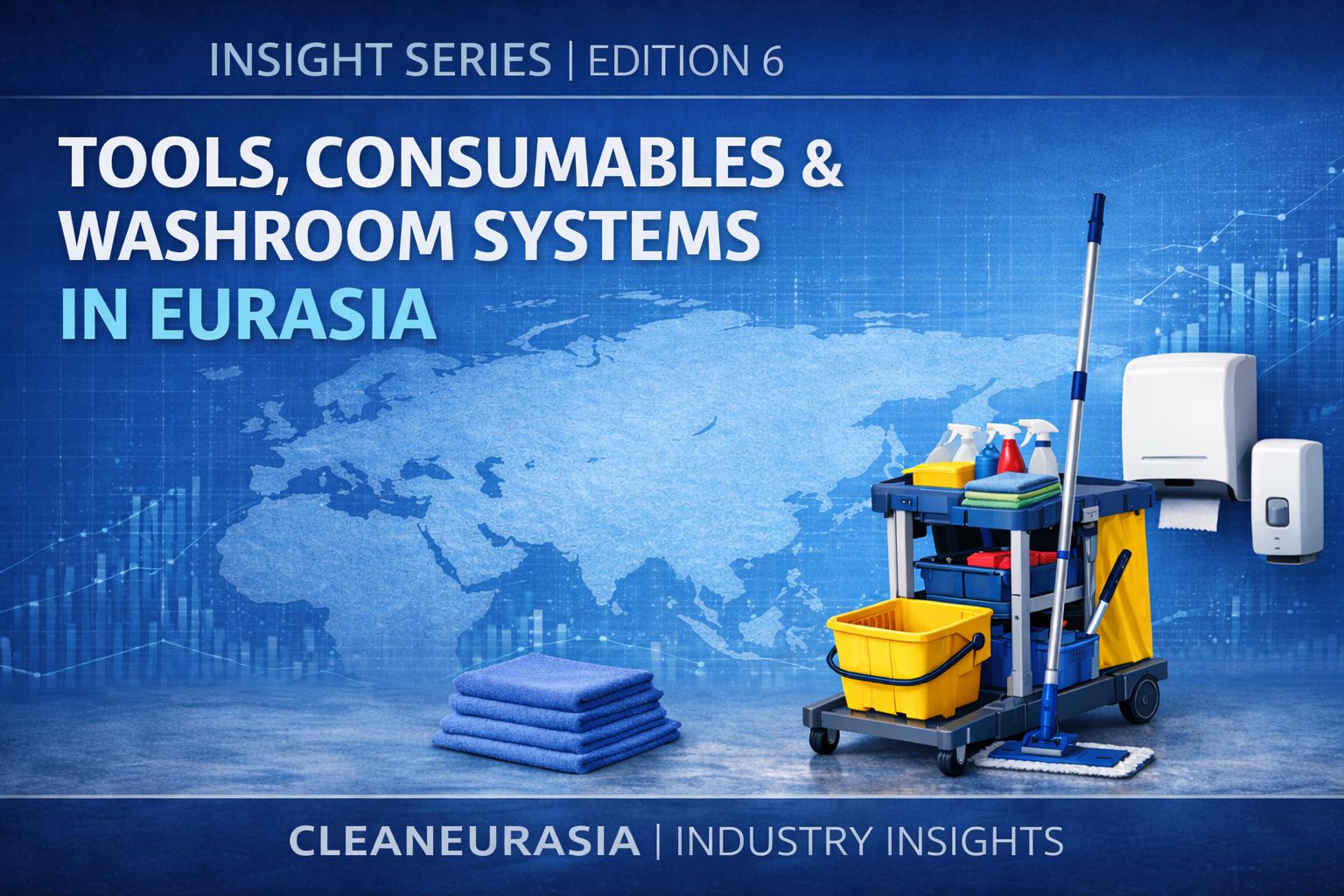
Opening Perspective Across Eurasia, tools and consumables represent the daily operational backbone of professional cleaning. Unlike machines, which follow capital investment cycles, tools and consumables operate through continuous consumption and replacement. Every facility service contract — from hospitals and airports to hotels and logistics centers — relies on a constant flow of microfiber textiles, mop systems, janitorial carts, and hygiene dispensing solutions. This makes the segment one of the most stable and scalable layers of the professional cleaning economy. 1️⃣ Global Product Segments — Market Size Indicators Several product categories dominate the professional cleaning tools ecosystem. Indicative global market ranges include: Microfiber cloths & mop textiles ≈ USD 4–5 billion Professional mop systems (frames, handles, buckets, wringers) ≈ USD 3–4 billion Window cleaning tools (squeegees, washers, telescopic poles) ≈ USD 1–2 billion Janitorial trolleys & cleaning carts ≈ USD 1–1.5 billion Washroom dispensers (soap, paper towel and toilet paper systems) ≈ USD 4–6 billion Air care & hygiene dispensing systems ≈ USD 2–3 billion Together, these product groups form a substantial portion of the operational supply layer within professional cleaning. 2️⃣ Microfiber — The Dominant Cleaning Technology Microfiber materials have transformed professional cleaning tools over the past two decades. Key advantages include: * higher dirt removal efficiency * reduced chemical consumption * lower water usage * faster cleaning cycles Across Europe — and increasingly across the Middle East — microfiber-based systems now dominate professional cleaning textiles and mop solutions. 3️⃣ Production Geography — Where These Products Are Manufactured Manufacturing of professional cleaning tools is concentrated in several specialized regions. Major production countries include: Italy Germany Turkey Spain Czech Republic China These regions host manufacturers producing: • mop systems • microfiber textiles • plastic cleaning tools • dispenser systems • janitorial carts Global supply chains often combine European product design, Turkish manufacturing capabilities, and Asian large-scale production. 4️⃣ Turkey — A Strategic Manufacturing Hub Turkey has become one of the most important production centers for professional cleaning tools in the Eurasia region. Key structural advantages include: * strong plastics manufacturing industry * flexible private-label production * competitive production costs * geographic proximity to both European and Middle Eastern markets Turkish manufacturers export extensively to markets across Europe, the Balkans, and the Middle East, particularly in product categories such as mop frames, buckets, wringers, and janitorial carts. This positioning allows Turkey to function as a regional manufacturing and supply bridge within the Eurasia cleaning economy. 5️⃣ Washroom Systems — Structured Hygiene Infrastructure Washroom hygiene systems represent a growing and increasingly structured subsegment within the tools ecosystem. Key product categories include: * soap dispensers * paper towel systems * toilet paper dispensers * air care systems * touchless hygiene technology Demand for these systems is increasingly driven by: • controlled consumption models • sustainability targets • hygiene compliance standards As hygiene expectations rise globally, dispenser systems are becoming a permanent component of institutional cleaning infrastructure. Strategic Insight While robotics and automation attract the industry spotlight, tools and consumables remain the volume engine of professional cleaning operations. Across Eurasia, this segment continues to scale through institutional hygiene standards, private-label manufacturing expansion, and strong regional production hubs — particularly in countries such as Turkey.