CleanEurasia Insights | The Future of Cleaning & Hygiene in Healthcare
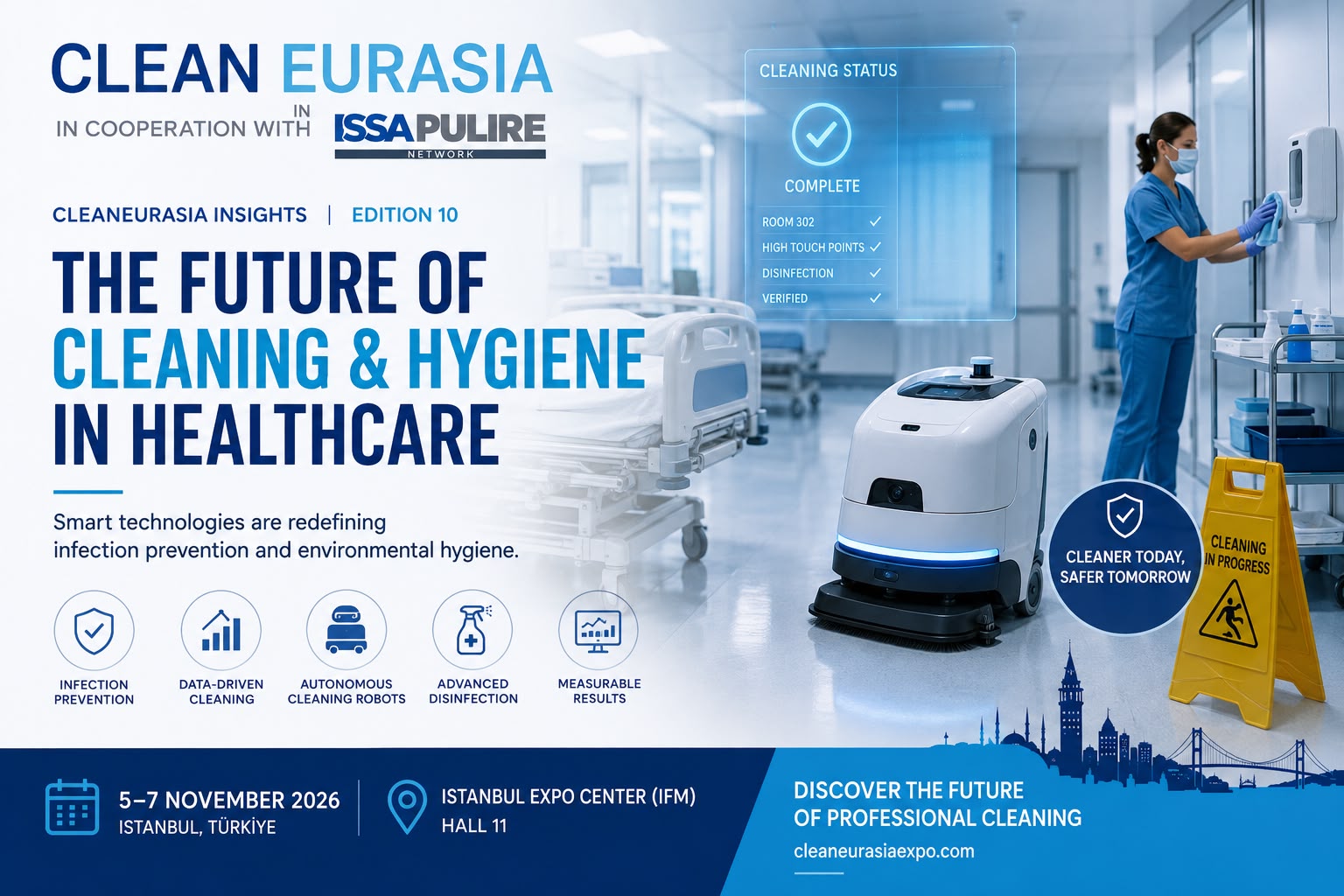
In healthcare, clean is not enough. It has to be measurable.
Hospitals and healthcare facilities are among the most demanding environments for professional cleaning. Every surface, patient room, operating area and high-touch point can play a role in maintaining a safe healthcare environment.
As expectations around infection prevention continue to evolve, healthcare cleaning is moving beyond traditional routines.
Automation, artificial intelligence, digital monitoring, autonomous cleaning robots and advanced disinfection technologies are helping transform hospital cleaning into a more measurable, traceable and data-driven process.
The future of hospital hygiene will increasingly depend not only on whether an area has been cleaned, but also on how effectively, consistently and verifiably that cleaning has been performed.
Healthcare Cleaning Is Becoming Part of Infection Prevention
Environmental cleaning has an important role within broader infection prevention and control strategies.
Healthcare environments contain thousands of frequently touched surfaces, including:
* Bed rails
* Door handles
* Medical equipment surfaces
* Nurse stations
* Touchscreens
* Elevator buttons
* Washroom surfaces
* Waiting areas
Effective cleaning and disinfection protocols help reduce environmental contamination and support safer conditions for patients, healthcare professionals and visitors.
This is why environmental hygiene in healthcare is increasingly being approached as a structured process involving procedures, training, technology, monitoring and verification.
From Visual Cleaning to Measurable Cleaning
For decades, cleaning quality was often assessed primarily through visual inspection.
But a surface that looks clean is not necessarily evidence that a cleaning protocol has been completed effectively.
Healthcare facilities are therefore increasingly exploring verification technologies and structured monitoring systems.
Depending on the application, these may include:
* ATP testing
* Fluorescent marker systems
* Digital cleaning records
* Automated task verification
* Environmental monitoring
* Real-time performance dashboards
These tools can provide facility and hygiene teams with additional information about whether cleaning procedures are being performed consistently.
The shift is fundamental:
Cleaning is becoming measurable.
Data-Driven Hospital Cleaning
Digitalization is changing how healthcare cleaning teams manage daily operations.
Connected cleaning management platforms can help monitor:
* Cleaning schedules
* Room status
* Staff assignments
* Completed tasks
* Equipment utilization
* Chemical consumption
* Response times
* Cleaning performance indicators
Instead of relying entirely on fixed cleaning schedules, facilities can increasingly use operational data to allocate resources according to actual demand.
A patient room, operating environment, emergency department and administrative office do not necessarily require the same cleaning frequency or protocol.
Data-driven cleaning makes it possible to develop more targeted approaches.
High-Touch Surfaces Remain a Critical Focus
Certain surfaces are touched much more frequently than others.
In healthcare environments, these high-touch surfaces require particular attention within cleaning and disinfection programs.
Technology can support this process by helping cleaning teams identify priorities, record completed tasks and monitor compliance.
Smart sensors, digital checklists and connected facility systems may eventually enable cleaning schedules to respond dynamically to occupancy and usage patterns.
Rather than cleaning every area according to the same timetable, the facility can direct resources where they are needed most.
Autonomous Cleaning Robots in Hospitals
Autonomous cleaning robots are becoming increasingly visible across airports, shopping centers, commercial buildings and healthcare facilities.
Hospitals present a particularly interesting environment for this technology.
Autonomous floor-cleaning machines can perform repetitive cleaning tasks while generating operational data about routes, coverage and machine performance.
Potential benefits include:
* Consistent floor-cleaning routines
* Better utilization of cleaning teams
* Digital documentation
* Increased operational visibility
* Reduced repetitive manual work
The objective is not simply to replace human labor.
Automation can allow cleaning professionals to focus more attention on complex tasks, high-touch surfaces and areas requiring human judgement.
The Changing Role of UV-C and Automated Disinfection
Automated disinfection technologies have also gained attention within healthcare environments.
UV-C systems, for example, may be used as an additional disinfection measure in certain controlled applications and protocols.
However, automated disinfection should not be viewed as a substitute for proper environmental cleaning.
Instead, these technologies can form part of a broader infection prevention strategy when appropriately selected, validated and operated.
The future is therefore likely to involve a combination of:
Professional cleaning + targeted disinfection + verification + data.
Smarter Chemical Management
Chemical management is another area undergoing digital transformation.
Modern dosing systems can help control the amount and concentration of cleaning chemicals used across healthcare environments.
Connected systems can also provide information on:
* Chemical consumption
* Stock levels
* Dosing accuracy
* Usage patterns
* Replenishment requirements
More precise chemical management can support consistency while helping reduce unnecessary consumption and operational waste.
Smart Washrooms and Touchless Hygiene
Healthcare hygiene extends far beyond patient rooms.
Washrooms, public areas and staff facilities are also important parts of the overall hygiene environment.
Touchless technologies are increasingly being integrated into healthcare facilities, including:
* Sensor-operated taps
* Touchless soap dispensers
* Automated hand-drying systems
* Smart consumable dispensers
* Occupancy monitoring
* Refill alerts
Connected washroom systems can help facility teams understand usage patterns and respond to actual demand rather than relying solely on fixed inspection schedules.
This creates a more proactive approach to smart hygiene management.
AI and Predictive Cleaning
Artificial intelligence could take healthcare cleaning one step further.
By combining information from occupancy sensors, building management systems, cleaning records and equipment data, AI-powered platforms could help predict where and when cleaning resources will be required.
For example, future systems could potentially identify unusually high traffic in a particular area and automatically prioritize additional cleaning.
The result is a transition from:
Scheduled Cleaning → Demand-Based Cleaning → Predictive Cleaning
This could become one of the most important developments in professional healthcare cleaning.
Sustainability and Healthcare Hygiene
Healthcare facilities must maintain demanding hygiene standards while also managing energy, water, chemicals and waste responsibly.
These objectives do not have to conflict.
Modern cleaning technologies can help facilities optimize:
* Water consumption
* Chemical usage
* Equipment efficiency
* Consumables
* Waste generation
* Cleaning routes
Sustainability in healthcare cleaning should therefore not mean reducing hygiene standards.
It means achieving the required hygiene outcomes through smarter and more efficient resource management.
The Future of Hospital Hygiene
The healthcare cleaning operation of the future will be increasingly connected.
Cleaning equipment will generate data.
Sensors will monitor usage.
Digital platforms will coordinate tasks.
Automation will handle repetitive processes.
Verification technologies will help assess performance.
Artificial intelligence will support decision-making.
But technology alone will not define the future of healthcare hygiene.
People, training, protocols and professional expertise will remain essential.
The most successful healthcare environments will combine human expertise with intelligent technologies to create cleaning operations that are:
More measurable.
More consistent.
More efficient.
More connected.
And ultimately, better equipped to support safer healthcare environments.
⸻
Discover the Future of Healthcare Cleaning at CleanEurasia 2026
From hospital hygiene and infection prevention technologies to autonomous cleaning robots, professional chemicals, smart dispensers, digital monitoring and next-generation cleaning equipment, healthcare is becoming one of the most technology-driven areas of professional cleaning.
CleanEurasia 2026 brings together manufacturers, distributors, healthcare professionals, facility managers, cleaning service providers and technology companies to explore the solutions shaping the future of professional hygiene.
5–7 November 2026
Istanbul Expo Center (IFM), Hall 11 | Istanbul, Türkiye
Technology. Hygiene. Innovation.
Discover the future of professional cleaning at CleanEurasia 2026.
.jpeg)

