Future of Cleaning | Edition 1 Cleaning Robotics in Eurasia Automation, Labor Economics & the Next Phase of Facility Cleaning
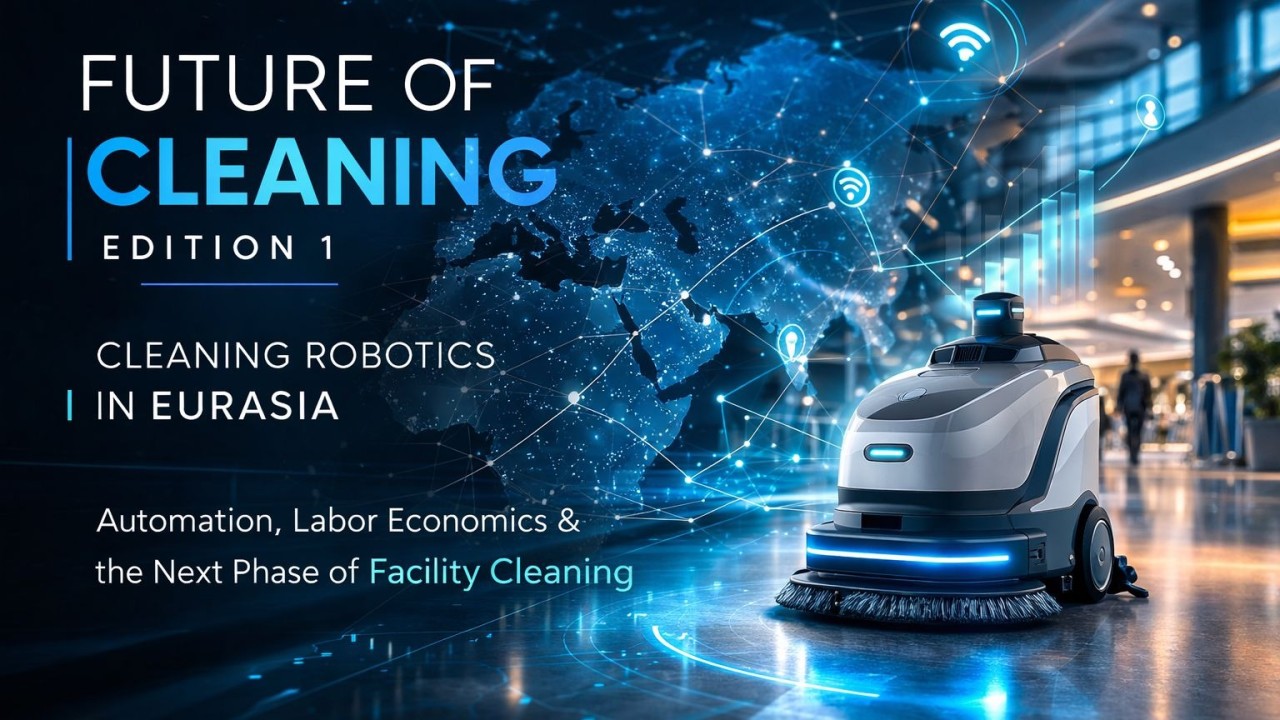
Global Cleaning Robotics Market The global cleaning robot market — including both residential and commercial systems — is estimated at approximately USD 6 billion. The market is expected to grow at over 20% annually, driven by advances in automation, sensors and artificial intelligence. However, within this broader market, the professional cleaning robotics segment represents a smaller but rapidly expanding category. Professional Cleaning Robotics Segment Robotics designed specifically for commercial environments — such as airports, hospitals, shopping malls and logistics facilities — is gaining traction. Indicative market estimates suggest: * Professional cleaning robotics market: USD 1.5–2.5 billion * Expected annual growth rates: 20%+ * Forecast to exceed USD 5 billion by 2030 Autonomous floor scrubbers and vacuum robots currently represent the largest share of deployments in the professional segment. Operational Capacity of Cleaning Robots Autonomous cleaning robots are designed primarily for large commercial environments where repetitive cleaning cycles and wide floor areas create favorable conditions for automation. Typical operational indicators suggest: * Autonomous floor cleaning robots typically cover 1,000–3,000 m² per hour, depending on machine size and facility conditions. * Large facilities often deploy one robot per 20,000–40,000 m² of floor area. * Robots are most efficient in environments with large open spaces and predictable cleaning routes. These environments include airports, logistics centers, convention venues and large retail complexes. Service Robotics Market Context Cleaning robots are part of the broader service robotics industry, which has expanded significantly in recent years. Recent industry estimates indicate: * Global service robot sales exceeded 150,000 units annually in professional applications. * Cleaning robots represent one of the largest segments of professional service robotics. * Autonomous cleaning solutions are increasingly deployed in facility management, healthcare and transportation infrastructure. Eurasia — A Strategic Growth Corridor The Eurasia region — spanning Europe, Turkey, the Middle East and Central Asia — represents one of the most promising environments for the expansion of cleaning robotics. Several structural drivers support this trend: * expanding facility management sector * large-scale infrastructure projects * growth in logistics and hospitality industries * rising labor costs in developed markets Key facility types driving adoption include: * airports * hospitals * shopping malls * logistics centers * hotels and resorts * convention venues Turkey — A Strategic Gateway Turkey plays a unique role within the Eurasia cleaning economy. With a population exceeding 85 million and a rapidly expanding facility services sector, the country represents both a growing domestic market and a regional gateway for emerging cleaning technologies. Key indicators include: * Turkish facility management market estimated at USD 15–20 billion * Over 10,000 large commercial facilities, including malls, hospitals, airports and hotels * Major international airports handling more than 200 million passengers annually Turkey’s geographic position connecting Europe, the Balkans, Central Asia and the Middle East makes it an important regional hub for the distribution and integration of cleaning robotics technologies. Strategic Insight Although robotics still represents a relatively small share of the professional cleaning economy, its influence is expanding rapidly. Across Eurasia, autonomous cleaning systems are beginning to complement traditional cleaning operations — improving operational consistency, productivity and cost efficiency. The future of facility cleaning will likely rely on hybrid operational models, combining human expertise with robotic systems.